[1]:
try:
  import google.colab
  %pip install -q ugropy
except ImportError:
  pass
Failing fragmentations

ugropy may fail to obtain the subgroups of a molecule for a certain model for two reasons: either there is a bug in the code, or the molecule cannot be represented by the subgroups of the failing model.
ugropy utilizes SMARTS for the representation of functional groups to inquire whether the molecule contains those structures. Let’s examine the functional group list for the classic liquid-vapor UNIFAC model.
[2]:
from ugropy import unifac

unifac.subgroups
[2]:
| smarts | molecular_weight | |
|---|---|---|
| group | ||
| CH3 | [CX4H3] | 15.03500 |
| CH2 | [CX4H2] | 14.02700 |
| CH | [CX4H] | 13.01900 |
| C | [CX4H0] | 12.01100 |
| CH2=CH | [CH2]=[CH] | 27.04600 |
| ... | ... | ... |
| NCO | [NX2H0]=[CX2H0]=[OX1H0] | 42.01700 |
| (CH2)2SU | [CH2]S(=O)(=O)[CH2] | 92.11620 |
| CH2CHSU | [CH2]S(=O)(=O)[CH] | 91.10840 |
| IMIDAZOL | [c]1:[c]:[n]:[c]:[n]:1 | 68.07820 |
| BTI | C(F)(F)(F)S(=O)(=O)[N-]S(=O)(=O)C(F)(F)F | 279.91784 |
113 rows × 2 columns
For example, let’s check the SMARTS representation of the alcohol group ACOH:
[3]:
unifac.subgroups.loc["ACOH", "smarts"]
[3]:
'[cH0][OH]'
The SMARTS representation it’s telling us that the ACOH group it’s, of course, a hydroxyl group bounded by a single bound to an aromatic carbon atom.
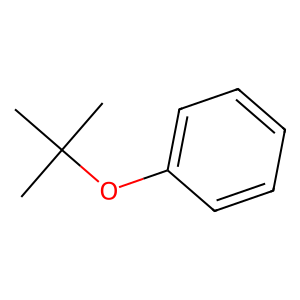
An example of a molecule that cannot be represented by UNIFAC groups:
[4]:
from rdkit.Chem import Draw


mol = unifac.get_groups("C1(=CC=CC=C1)OC(C)(C)C", "smiles")

Draw.MolToImage(mol.molecule)
[4]:
[5]:
print(mol.subgroups)
{}
The library “fails” to obtain any functional groups to accurately represent the molecule. This failure is represented by an empty dictionary. In this case, the “fail” is correct, but it could fail due to errors in the groups SMARTS representations or the algorithm, resulting in an empty dictionary as well. Currently, the supported models are tested against different molecules available in the Tests Book section of the documentation.
If you encounter a failing representation, you can examine the structure of the molecule and the list of functional groups of the failing model. If you determine that the molecule can indeed be modeled, you may have discovered a bug. Feel free to report the issue on the repository along with the failing molecule’s SMILES/name, the failing model and the ugropy version:
https://github.com/ipqa-research/ugropy/issues
This could be useful in cases where some groups have more interaction parameters than others in the mixture that you want to model with UNIFAC. Alternatively, you can try both approaches and compare if there are any differences.